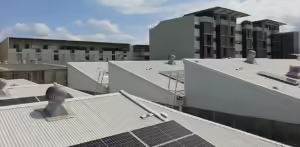

The need for compliant fall protection comes from the risk, not how often work is done.
“We only need to get up there once in a blue moon.”
There are myriad reasons why a height safety system might be non-compliant, inadequate or absent entirely from a building. But the “it’s just not accessed that often” is the most common reason we hear by far.
Infrequent or irregular access does not mean the level of risk that workers are exposed to is, in any way, lessened. Even if it can feel like that to the casual observer.
From the moment someone needs to go up, height safety systems need to exist, be compliant and provide the highest level of protection reasonably practicable.
Protection is always needed
It is easy to think that because an area is accessed infrequently there is a lower level of responsibility required to manage the safety risks that exist. There is not.
This is especially true when it comes to working at height. Infrequent or irregular access of a roof or other area can introduce far more risks, increasing the chances of a fall occurring, than an area where work is undertaken more often.
The frequency of work does not change the requirement to manage the risks on site. That happens from the moment it is decided that work is going to be undertaken.
There is no carve-out in the Work Health and Safety Act 2011 (NSW) that adds a qualification around work timing to the responsibilities of a Person Conducting a Business or Undertaking (PCBU). Protecting workers must be done whether it is the first time an area is being accessed or the 100th.
PCBUs should also be aware that in July 2026, the Act was updated to include a new s26A. This section makes it mandatory for an approved Code of Practice to be complied with unless it can be demonstrated the management of risks offers an equivalent or higher standard of protection.
The two main codes relating to working at height that PCBUs must now follow are Managing the risks of falls at workplaces and Work on roofs – commercial and industrial buildings.
Infrequent access can create additional risks
While height safety systems are installed on sites where it is known that work is going to be undertaken on a regular or scheduled basis, the same is not true for other areas. There are many reasons why access to a roof or other area may be required when it has not been before.
While gutter cleaning is a regular task in an area with a lot of trees, a building in a newly developed area is unlikely to need that work done often. Dilapidation can lead to leaks. Severe storms can cause damage. Over time plant and equipment can be installed or moved. Even just the general state of the roof can change over time.
The need for infrequent or irregular access is generally reactive. Something has changed, something has broken, something needs repairs and access is suddenly needed to an area that is rarely, if ever, visited.
Not having regular access to an area can mean that nobody involved in the work has a working knowledge of the work area and the risks that could exist there. Workers in these circumstances also tend to be contractors or other third-parties.
This lack of knowledge coming from all directions can combine to leave workers without a clear understanding of the area they are about to enter. In an effort to accomplish the work they need to do in a timely manner they may not take time to adequately identify and mitigate risks.
In situations where a height safety system exists, infrequent access can lead to those systems not being maintained or kept compliant. When the sudden need for access arises, the system is not ready. Work needs to be delayed while the system is rectified to a compliant state. Otherwise, there is a risk workers may inadvertently, or deliberately, proceed using a system that is not compliant or safe.
What can be done?
In the first instance, an existing height safety and fall protection system should be regularly inspected and kept compliant with the relevant Australian Standards along with the manufacturers’ instructions.
If a permanent height safety system is not installed, then it is important to understand what sort of protection is being used, and whether or not it is adequate for the work being done.
Many temporary height safety and fall protection systems can be used when access to an area is a once-off. However, if access is made repeatedly, to the same area, using these systems – even if there is a prolonged time gap between them – investigation of a permanent solution would be more beneficial.
Many temporary systems, particularly temporary roof anchor points, are designed to be used in one location, once. Reusing them in the same area multiple times can reduce their effectiveness in the event of a fall. This increases the risks faced by the worker.
Before any work is undertaken, time should be taken to identify and assess any risk areas in the work area. For work on roofs this could include skylights, dilapidated roof sheets, and other areas that may not be trafficable.
Anyone accessing the area, or requiring people to access the area, should develop and implement appropriate processes and procedures that protect the worker from the fall risks associated with it. They should also ensure the worker has the skills and competency required to safely access the area and conduct the work.
Partners in protecting people
Height Safety Engineers can investigate, assess and mitigate the potential fall risks that exist in a variety of work environments. Our team brings decades of real-world experience to designing and installing height safety systems to mitigate those risks.
Understanding your workplace and having systems in place are the first steps in making sure people are protected. Start your safety journey today by calling 1300 884 978, emailing [enquiries@heightsafety.net](mailto:enquiries@heightsafety.net) or by sending an enquiry through our contact page.