
SafeWork NSW introduced a new code of practice for working on commercial and industrial building roofs in May 2026. Here’s what you need to know.
Work on roofs – commercial and industrial buildings is a new code of practice developed by SafeWork NSW and released in May 2026.
It is a replacement for the old Safe work on roofs. Part 1: Commercial and industrial buildings code that was initially released in 2009, some 17 years ago and prior to the national harmonisation of workplace health and safety laws.
The new code assists PCBUs in implementing the changes to fall protection work methods introduced in AS/NZS 1891.4:2025. It is also written to consider changes to the NSW Work Health and Safety Act 2011 that came into force on 1 July 2026.
The 2026 work on roofs code of practice is a hefty, detail-heavy document. While every PCBU must be across it, our team have compiled the key improvements and what they mean for you, your team and your workplace.
“Must” is a very important word now
The very first section of the new code ties specific duties of PCBUs (person conducting a business or undertaking) to their respective sections within the Work Health and Safety Act.
The most substantive change here is that the code no longer has these duties as suggestions. Their being tied to the Act has resulted in every “should” or “may” being replaced with a “must”
Starting 1 July, clause 26A will be inserted in the Act. The clause represents a substantive shift in compliance for a PCBU. It makes an approved code of practice now legally enforceable. In effect, it is now a “must” do, rather than a “should” do. PCBUs can still implement other forms of risk control, but it must be demonstrated those controls provide an equivalent or higher standard of protection for workers compared to the code..
Queensland made the same change to their Act back in 2018 and NSW is now following suit.
Work on roofs – commercial and industrial buildings is a ministerially approved code of practice. The directions contained within it will be legally binding.
In effect, this means the Code now sets what is considered a minimum standard for safety. So compliance with the code is not an option, it is a requirement.
There is flexibility still in how the individual requirements within the code are met (“should” and “may” directions are not entirely absent). However, the outcomes now being tied to law will mean that deviation from the code will be hard to defend in the event of an accident.
Put into context of the document as a whole, this initial section outlines what is required to be done, while the sections that follow provide instruction on how those requirements can be sufficiently met.
What is a flat roof?
The changes made regarding flat or low-pitched roofs are the area most likely to have a direct effect on an existing fall protection system.
Previously, a roof with a pitch of 15° or greater required workers to be connected to a fall protection system at all times while on the roof.
The 2026 code updates this. The requirement is now that a worker must be connected when within three (3) metres of any fall edge if the roof is pitched at 7° or greater.
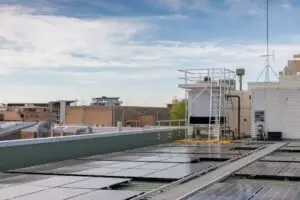
Where this is likely to cause issue is accessing systems that are near roof edges. For example, a static line system may be installed two (2) metres from a roof edge, around a series of solar panels. Where the roof access point is more than three metres away, the worker could potentially enter within the three-metre no-go zone prior to connecting to the static line. This would be in breach of the code.
The layout of fall protection systems on many lower pitched roofs may now need to be looked at closely by workers to ensure they are complying with the code of practice.
Types of roof
For the first time, the differences between a commercial building and an industrial building’s roof have been defined, and flow-on effects for fall protection systems demonstrated.
The distinction made in the code can seem odd at first glance but does make sense. Industrial roofs are generally roofs that do little more than protect workers, plant and equipment from the elements. Commercial roofs are more complex and can incorporate elements for “multi-purpose use”.
What this means is that commercial buildings can have habitable areas (balconies, rooftop gardens, carparks) and other decorative structural elements (large glass ceilings and walls). Industrial buildings are large, open and generally only accessed when maintenance or repairs to specific rooftop items is required.
The distinction highlights that different approaches to fall protection and height safety systems should be used to best suit the different environments.
Harness-based fall protection systems
The position of SafeWork NSW has long been that they would prefer higher-order controls used to mitigate the risk of a fall at workplaces. That is, installation of guardrail, use of EWPs and, of course, not getting on the roof in the first place.
Naturally there are always going to be situations where those mitigations are not practicable.
To that end, the new code of practice adopts one of the most substantive changes to harness-based fall protection systems included in AS/NZS 1891.4:2025 – the hierarchy of fall protection systems.
In addition to the broader hierarchy of risk control, this selection process must be worked through to determine the most practicable option of the five main harness-based fall protection systems.
In order, they are total restraint, restrained fall, limited free fall, free fall and restraint technique.
Effects on existing fall protection systems
It is important to note the new code of practice governs the behaviour of workers out on site. It does not specify products, manufacturing or system design standards.
The code is for PCBUs, their workers and other involved parties to understand what is required of them when planning or executing work on site. The onus is on them to ensure that work methods meet the requirements of the code.
If a worker accesses a system and finds they cannot safely get to where they need to go, then the system needs to be inspected, assessed and potentially modified or upgraded.
An existing system is not automatically non-compliant by virtue of being installed prior to the code coming into force.
Effects on workers
Between the changes in AS/NZS 1891.4:2025 and now this code, the reality is that workers are going to require additional training. And that additional training will need to be done in line with these new documents.
So much of the foundational, fundamental work practice requirements have been modified, or changed completely, that it is very likely many workplaces are now working outside of both the standard and the new code of practice.
Inspectors from the regulator do not take ignorance of changes in legislative or regulatory documents as a reason for not following prescribed safe work practices. It is up to the PCBU and other relevant stakeholders to make sure they are followed. In this instance, that means refresher training for all workers accessing commercial and industrial building roofs.
What next?
The best course of action to take is to engage the services of a height safety and fall protection expert. Height Safety Engineers is well-placed to assist business of all shapes and sizes ensure they are meeting their obligations, complying with the legislative requirements and, most importantly, protecting people.
From HVAC maintenance teams, facility managers, gutter cleaners, skylight and solar installers, HSE have the expertise and know-how to provide practical and compliant fall protection to any workplace.
Get in touch with the HSE team by calling 1300 884 978, emailing enquiries@heightsafety.net or jumping onto our contact page here.