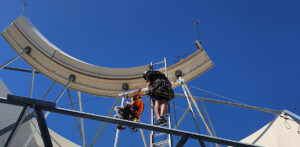

Skylights, fragile sheets and roof openings are the cause of many falls through, not off, roofs.
When people are considering the risks a height safety or fall protection system should be helping to mitigate, work near a roof edge is often what is front of mind.
Many height safety systems focus on making sure that workers either cannot access an exposed fall edge or, if they need to, cannot put themselves in a position where a fall off it could occur.
However, a spate of recent incidents has highlighted the need to consider not just areas where workers can fall off a roof, but also the circumstances in which they can fall through one.
Skylights, non-trafficable roof materials and the process of modifying a building’s roof all create circumstances where fall risks exist. Unfortunately, in many cases, these risks are not adequately identified and mitigated.
Falls through skylights and modified roof areas span many different industries, work environments and worker demographics.
Gravity does not, and will never, discriminate.
How falls through roofs happen
There are several different factors that contribute to falls through, as opposed to off, roofs.
Importantly, cutting or modifying roof sheets directly creates fall risks. Any modification to the roof places it in an incomplete state. Incomplete structures mean that existing safety systems may not function as designed.
Often, a contributing factor is that the risks are not given their due consideration as work is being undertaken. A lot of the focus when it comes to working at height is on edge protection, specifically where a roof ends or roof levels change. That an edge can also be present on the interior of a roof often goes unrecognised.
Even in environments where there are known risks there is still the potential for them to be overlooked in the moment. Many industrial buildings have skylight sheeting installed. These sheets often mimic the look of the main roof material but are unable to withstand a person’s weight.
Other types of raised skylights may also appear to be able to withstand being stood on by a person, but in most cases cannot.
Taking that one step further, even if the penetration is covered, the very existence of that cover can signal to a worker that the risk has been fully mitigated, when in fact the cover may not provide any protection at all.
Site processes and familiarity can also influence how these hazards are perceived. Inadequate site induction or pre-work safety review can leave hazards unidentified, while repeated familiarity with a workplace can mean known risks are no longer consciously reassessed.
The final significant contributor to falls through roofs is the common misconception that a “low-height” fall is not a dangerous one, when the reality is that even relatively short falls can cause serious or fatal injuries. The majority of serious and fatal falls from height occur at four metres or less.
How falls through roofs can be prevented
The most effective way of preventing falls through roofs, either through skylights, voids, other penetrations, or from modified roof sheets, is to have a thorough work methodology that has been given the time and attention required to be fully implemented. This starts with a comprehensive risk assessment and reference to the hierarchy of controls when it comes to determining suitable mitigation. Priority should be given, where reasonably practicable, to higher-order controls that prevent a person reaching or falling through the hazardous area.
Physical prevention measures should be the first line of defence when it comes to mitigating these types of fall risks. These can include guardrails around skylights and roof penetrations or the installation of covers.
If covers are to be used, s4.4 of Work on roofs – commercial and industrial buildings Code of Practice says it is preferred they are of a material that is clearly distinguishable from both roofing materials and any building materials. The covers should also be firmly secured in place and be able to withstand a concentrated load of at least 2kN. It is intended that covers, regardless of the material used, are considered to be non-trafficable. Efforts should be taken to minimise the risks that they are accidentally loaded by a person.
In many industrial buildings, a metal mesh is installed underneath the roof and skylight sheeting as part of the installation process. While this mesh can, in some circumstances, be used as a fall protection device after installation, its suitability and compliance should be thoroughly checked by a competent person prior to work starting.
Harnesses, roof anchors, fall arrest and fall restraint technique systems should only be considered after the higher-order preventative measures have been deemed to be not reasonably practicable for the work being done.
For works involving roof modifications, penetrations and working at height generally, the risk controls should be designed to mitigate foreseeable missteps and still function to prevent or protect against a fall even if a worker does make a mistake.
What NSW law requires
Since 1 July 2026, section 26A of the Work Health and Safety Act 2011 (NSW) requires a PCBU to comply with an approved Code of Practice or manage the relevant hazards and risks in another way that provides an equivalent or higher standard of health and safety. Any variance from an approved code of practice must be justifiable on these grounds.
For roof work, this makes the control measures contained in the applicable Codes considerably more important when planning and carrying out the work.
In the event a fall does occur, the PCBU may be found to have liability if the guidance and recommendations outlined in the Code of Practice have not been followed.
Partners in protecting people
Height Safety Engineers works with builders, construction and facility managers, owners and tradespeople every day on providing compliant, comprehensive and easy-to-use height safety and fall protection systems.
Our team can assist in providing assessments for all your roof safety needs. Contact us by calling 1300 884 978, sending an email to enquiries@heightsafety.net or by getting in touch via our contact page.